Event Details

Understanding the detailed information available for each detected earthquake event.

Accessing event details

  1. Open the event catalog
  2. Click on an event row
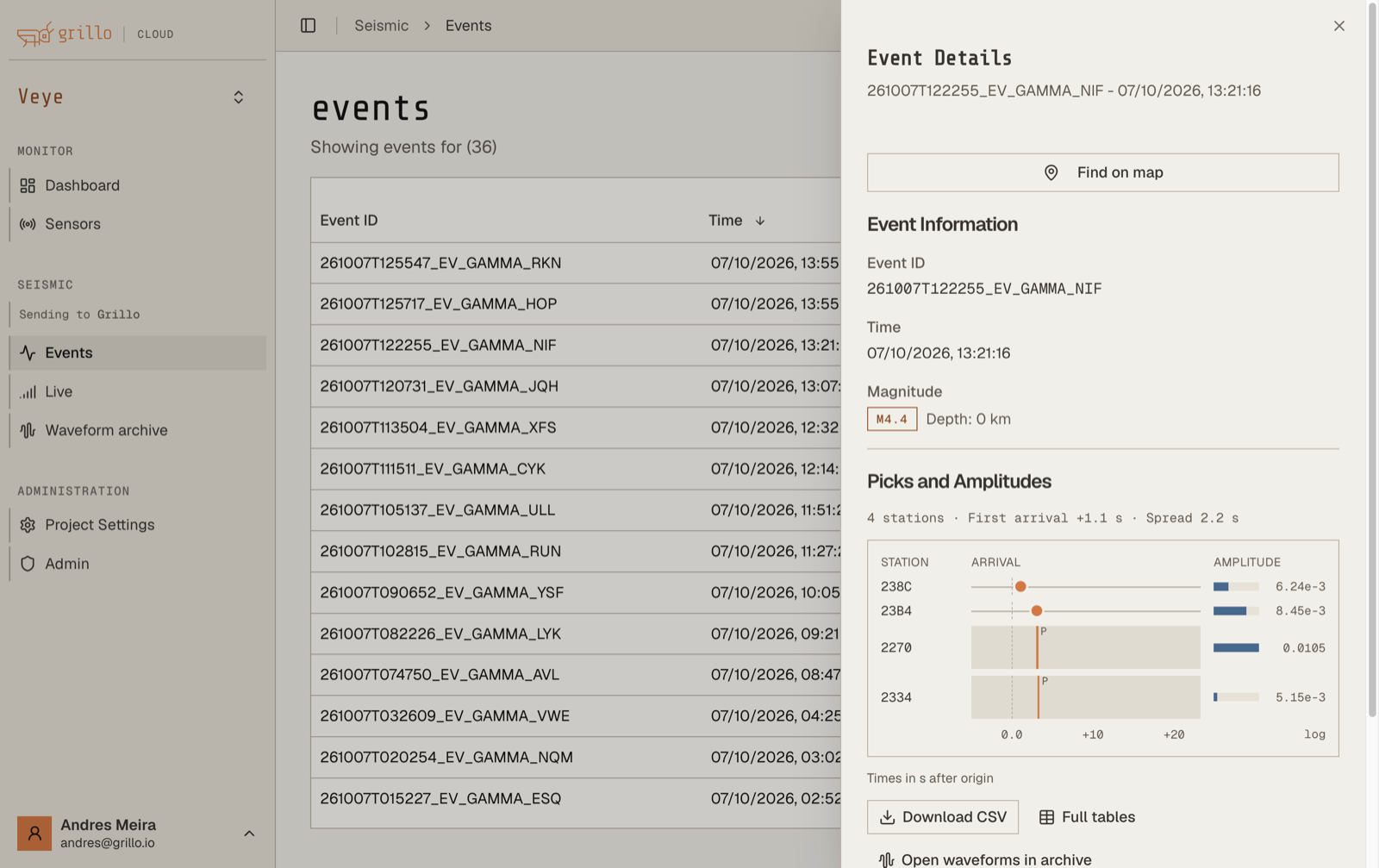
  3. The event detail view opens

Event details

Event detail sections

The top section shows:

  • Event ID
  • Date and time
  • Magnitude (prominent display)
  • Location summary
  • Event status

Location map

Interactive map showing:

  • Epicenter location (star/circle)
  • Station positions (triangles)
  • Uncertainty ellipse
  • Regional context

Map controls:

  • Zoom in/out
  • Pan to explore
  • Toggle layers

Origin information

Detailed source parameters:

ParameterExampleDescription
Origin time2024-01-15 14:32:45 UTCWhen earthquake occurred
Latitude37.7749° NEpicenter latitude
Longitude122.4194° WEpicenter longitude
Depth8.5 kmDepth below surface
Location5 km NE of CityGeographic reference

Magnitude information

ParameterExampleDescription
Magnitude4.2Event size
Magnitude typeML (local)Calculation method
Uncertainty±0.2Margin of error

Quality metrics

Solution quality indicators:

MetricGoodPoorDescription
Stations used10+Less than 4Sensors in solution
Azimuthal gapLess than 90°More than 180°Angular coverage
RMS residualLess than 0.5sMore than 2.0sFit quality
Horizontal errorLess than 5kmMore than 20kmLocation uncertainty
Depth errorLess than 5kmMore than 20kmDepth uncertainty

Station data

Contributing stations

List of sensors that detected the event:

ColumnDescription
StationStation code
DistanceFrom epicenter
P arrivalP-wave arrival time
S arrivalS-wave arrival time
AmplitudeMaximum ground motion
ResidualTiming residual

Station map

Map showing:

  • Station locations
  • Distance circles from epicenter
  • Color-coded by amplitude/arrival

Waveforms

Waveform display

View seismic recordings from each station:

  • Time-aligned to event
  • Filtered display options
  • P and S picks marked

Waveform controls

ControlFunction
ZoomExpand time/amplitude
PanScroll through time
FilterApply frequency filter
StackOverlay multiple traces

Amplitude information

Peak ground motion values:

  • PGA (Peak Ground Acceleration)
  • PGV (Peak Ground Velocity)
  • Response spectra (if available)

Event timeline

For rapidly updating events:

  • Initial detection time
  • Parameter updates
  • Final solution time
  • Alert delivery times

Comparing events

View this event in context:

  • Similar past events
  • Regional seismicity
  • Sequence analysis (aftershocks)

Event status

Automatic

Initial automatic solution:

  • Generated by algorithm
  • May be revised
  • "Preliminary" label

Reviewed

After human review:

  • Quality checked
  • Parameters verified
  • "Reviewed" label

Final

Authoritative solution:

  • No further changes expected
  • Published to catalog
  • "Final" label

Actions

Available actions for events:

ActionDescription
ExportDownload event data
ShareGet shareable link
ReportFlag issue with event
PrintPrint-friendly view

Export options

Export individual event:

  • Full parameter file
  • Waveform data
  • Station data
  • Maps and images

Formats:

  • QuakeML (standard format)
  • JSON
  • CSV
  • PDF report

Understanding uncertainties

Location uncertainty

Shown as an error ellipse on the map:

  • Semi-major axis length
  • Semi-minor axis length
  • Orientation

Smaller ellipse = more confident location.

Magnitude uncertainty

Expressed as ± value:

  • M 4.2 ±0.2 means likely between 4.0-4.4
  • Uncertainty decreases with more stations

Why uncertainties vary

FactorEffect on uncertainty
More stationsLower uncertainty
Better distributionLower uncertainty
Higher magnitudeLower uncertainty
Station noiseHigher uncertainty